
14/09/25
As the CPS is focused on the Economic Justice campaign this session focused on the dilemma of intra-African migration and the African diaspora within Africa, examining the complex dynamics of migrant workers’ experiences, particularly between Swaziland and South Africa. The General Secretary of the Communist Party of Swaziland (CPS) presented an analysis of how migration patterns are shaped by colonial history, capitalism, and class struggles. The discussion explored how migrant workers are often exploited as cheap labor while simultaneously being scapegoated for economic problems in host countries.
The migration patterns within Africa, particularly from countries like Swaziland to South Africa, have deep historical roots in colonialism and capitalism. During colonial times, migration was systematically organized to provide cheap labor for mining and other industries. The General Secretary noted that “the migrant labor system was a product of colonization” designed to extract maximum profit through exploitation of workers.
This system created dependencies where countries like Swaziland saw large portions of their population—sometimes nearly half—working in South African mines and sending remittances home. Post-colonial governments have maintained these exploitative structures, with the monarchy in Swaziland even encouraging graduates to leave the country to find work elsewhere. The discussion highlighted how colonial borders divided African people artificially, creating the paradoxical situation of “African diaspora in Africa.” These historical patterns continue today, though in modified forms, as economic necessity drives people to migrate despite increasingly hostile reception in destination countries.
A central theme of the discussion was the need for migrant workers to develop a clear class identity and organize effectively. The General Secretary emphasized that “the most lacking element is that the migrant workers lack organization and they lack affirmation.” This disorganization creates vulnerability and undermines class struggle in both home and host countries. Migrant workers often see themselves merely as individuals seeking better opportunities rather than as part of a broader working class with common interests. They focus narrowly on household livelihood rather than broader economic and political issues.
The GS argued that migrant workers must understand their role in production systems and develop solidarity with local workers in their host countries. This requires recognizing shared class interests across national boundaries and respecting the gains made by labor movements in countries like South Africa. Several participants emphasized that organization is the key to transforming the current situation where workers are pitted against each other into one where they can unite against their common exploiters.
The discussion addressed the growing xenophobic tensions in South Africa, where migrant workers are increasingly targeted as scapegoats for economic problems. The General Secretary noted that right-wing forces are mobilizing South Africans against foreign migrants, creating dangerous divisions within the working class. This serves the interests of the capitalist class by diverting attention from the real causes of unemployment and poverty.
The discussion highlighted incidents where migrants have been forcibly removed from hospitals and other public services. The speakers emphasized that these conflicts are manufactured to prevent working class unity and maintain minority rule.
To effectively address the challenges faced by migrant workers from Swaziland and other countries, it is essential to organize them into cohesive groups with a clear class identity. Building solidarity between these migrant workers and local working-class organizations, such as COSATU, can strengthen their collective bargaining power and foster unity across borders.
Developing educational materials focused on political economy will raise consciousness among workers, equipping them with the knowledge to understand and challenge the systemic forces that exploit them. Creating ongoing platforms for discussion ensures that migration issues are continuously examined from a class perspective, promoting sustained engagement and activism.
Furthermore, strengthening the campaign for the overthrow of the monarchy in Swaziland is crucial, as this struggle forms part of a broader regional class movement aimed at dismantling oppressive structures.
Finally, establishing common wage brackets across the continent will help prevent the exploitation of migrant workers by ensuring fair and standardized compensation regardless of national boundaries. Together, these strategies can build a powerful, united front to advance the rights and dignity of migrant workers throughout the region.
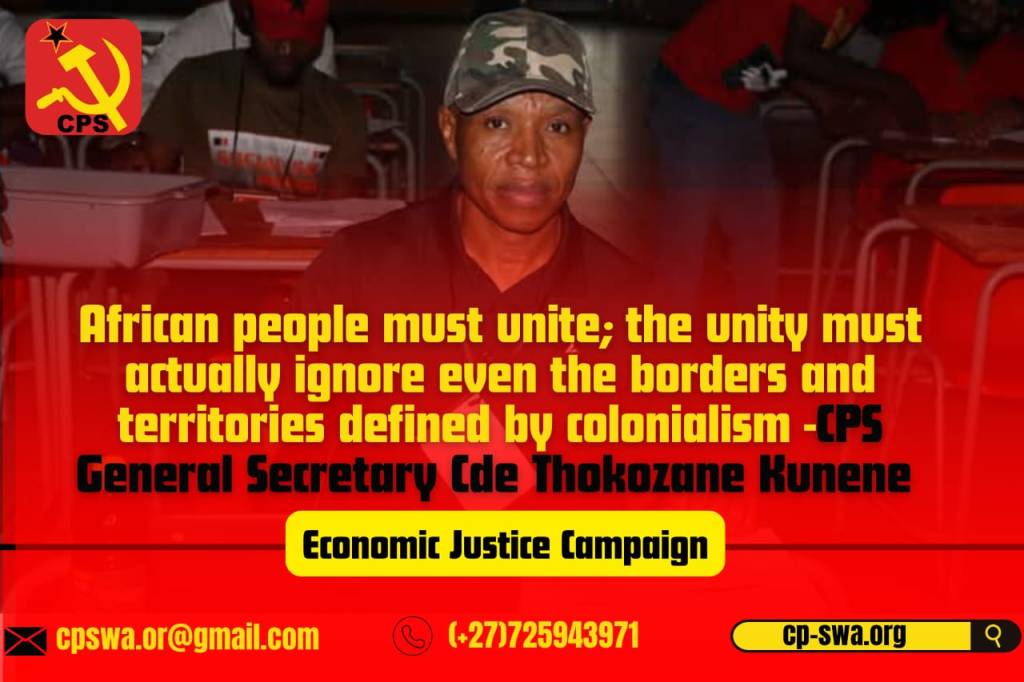
“African people must unite, the unity must actually ignore even the borders and territories that defined by colonialism” he emphasized.
CPS Press
📩 cpswa.org@gmail.com | 🌍 cp-swa.org | ☎️ (+27) 725943971
Follow our WhatsApp channel: https://whatsapp.com/channel/0029VajZOtp0G0XkNnX8sV2A
 Communist Party of Swaziland